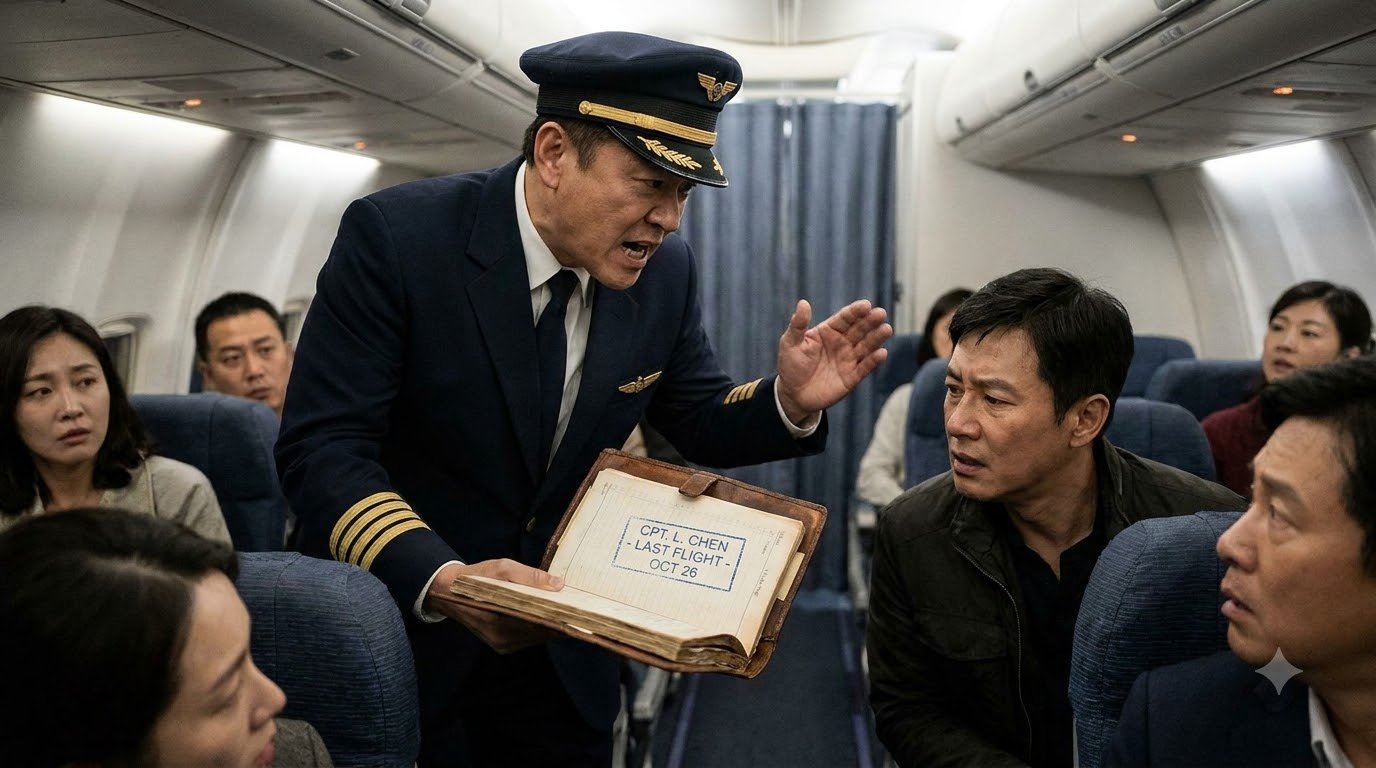
CHAPTER 2: The Officers Stepped Aboard As Miller Kept The Forged Stamp Covered
The lead officer had his radio clipped high on his shoulder harness, the mic cord bouncing against a yellow reflective stripe as he cleared the galley threshold. His partner stayed two paces behind him, blocking the narrow entry curtain with his thumbs hooked into his utility belt. Between them and my row, Miller remained planted in the aisle, his thumb still pressed over the lower edge of the maintenance release.
“Captain,” the first officer said, his eyes flicking from Miller’s brass stripes down to my work boots. “Gate control flagged an unresolved operational refusal on this flight. You have a passenger refusing an order to de-plane?”
Miller didn’t glance back at him. His gaze stayed pinned to my collar. “Passenger Keller was removed from active maintenance duty at fifteen hundred hours under company administrative suspension. He circumvented security checkpoints, purchased a revenue ticket under a personal credit profile, and boarded this aircraft without clearance from the regional director. He is interfering with flight operations.”
The passengers in row one had turned around in their leather seats. A man in 1C pulled out an iPad, tilting the camera toward the aisle until the second officer made a short, flat gesture with his open palm that put the screen back against the man’s knee.
“Show them the ticket line, Ray,” I said, keeping my hands resting flat on the armrests where both officers could see them. “Tell them what flight operations means on a grounded airframe.”
“Mr. Keller,” the lead officer said, stepping forward until his boot touched the metal track of Seat 2B. “The captain exercises operational authority once the boarding door is prepped for closure. If he asks you to leave the cabin, you leave. You take the dispute to the ticket counter or your union rep in the terminal. You don’t litigate it in the jetway.”
“I’m not litigating an employment dispute,” I told the officer, speaking directly into the space between his badge and Miller’s chest. “My name is David Keller. I’m a senior airframe and powerplant technician for Continental Skyway. The document Captain Miller is holding on that clipboard is the primary airworthiness sign-off for Flight 448. It certifies that the starboard engine bleed air system was inspected, pressure-tested, and cleared for icing conditions at four o’clock today.”
“The release is certified by an authorized inspector,” Miller cut in, his voice rising half an octave, sharp and tight. “The paperwork is complete. This man is not on the active flight roster, he has no inspection authority on this tail, and he is trespassing on company equipment.”
“Look at the stamp, Officer,” I said.
The lead officer hesitated. He was transit authority, trained for ticket disputes, gate runners, and drunk holiday travelers, not airworthiness directives. But he wasn’t blind. He looked at Miller’s hand, which was trembling slightly where the thumb held the pink form against the hardboard.
“Let me see the dispatch sheet, Captain,” the officer said.
“This is an internal operational manifest,” Miller answered without moving his hand. “Federal regulations require it to stay with the captain’s flight package until block-out.”
“And federal code requires every flight document to bear the valid seal of a living, licensed technician,” I said. “The stamp on line four belongs to Samuel Keller. License four-four-eight-one. My brother. Sam died twenty-one days ago in Hangar 4 when a scissors lift collapsed during a tailcone inspection. His tools, his locker, and his brass inspection dies were sealed by the National Transportation Safety Board the morning after the fall.”
A woman three rows back let out a sharp, ragged breath that carried over the low hum of the circulation fans.
The officer’s eyes widened slightly. He looked down at the paper, then back up at Miller’s shoulder. “Captain, lift your thumb.”
Miller’s face went the color of wet chalk. He didn’t lift his hand. He pulled the entire clipboard back against his ribs, his shoulders squaring as he tried to reassert the authority of the four gold bars on his epaulets. “Officer, this aircraft is thirty minutes behind schedule. We have a gate hold for inbound de-icing slots at O’Hare. If we miss our pushback window, this flight cancels, and two hundred people spend the night on concourse floors. I am ordering you to remove this man.”
“Lift the thumb, Captain,” the officer repeated, his tone dropping from routine caution to flat, professional suspicion. “Now.”
Miller stood rigid for three seconds. In the silence, the cabin vents hissed, pushing cold, dry cabin air across the carpet. Slowly, stiffly, Miller lowered the board flat toward the officer’s chest.
The purple stamp was right where I had seen it. Inspector S. Keller, License #4481. But beneath the purple ink, where the automated terminal code printed in fine thermal dots along the margin, the real story sat in plain black type: TERM-03-EXEC / USER: DIR_OPS_STEVENS / AUTH: OVERRIDE_PRIORITY_1.
It hadn’t come from the maintenance floor. It hadn’t come from the line shack where the grease monkeys keep the logbooks. It had been generated forty minutes ago from the executive terminal on the third floor of the corporate hangar—the office belonging to Marcus Stevens, the regional operations director who had signed the incident report blaming Sam for his own fatal fall.
The lead officer looked at the stamp, then leaned close enough to read the thermal line. “Who is Stevens?”
“My operations director,” I said, rising unhurriedly to my feet so neither officer would take it as a threat. I stood in the aisle, my head nearly touching the overhead bins, a full head taller than Miller. “And the man who told the federal board that Sam was working alone without safety harnesses because he was careless. But Stevens couldn’t clear Tail 814 for tonight’s storm on his own signature, because the FAA suspended his personal maintenance license six months ago after an audit in Detroit. He needed an active master stamp on the sheet to clear the automated dispatch lock at the gate. So he broke the seal on Sam’s estate locker, pulled my dead brother’s brass die out of the evidence box, and stamped this release himself.”
“That is an unsubstantiated accusation,” Miller snapped, his knuckles whitening on the board’s metal clip. “You have no proof of where this paperwork originated.”
I reached into the inner breast pocket of my work coat. The second officer’s hand dropped toward his holster, but I pulled out only a heavy, clear plastic evidence pouch containing a single brass key tagged with yellow terminal maintenance tape.
“This is the master key to the Hangar 4 tool crib,” I said, holding it out where both the officers and the passengers in the front rows could see the stamped serial numbers. “Sam had the only duplicate. When I went down to the line shack at five o’clock to inspect the cracked bleed valve on engine two, the lock on Sam’s locker wasn’t cut. It had been opened with the director’s electronic passkey at four-fourteen this afternoon. The log on the card reader records every badge swipe. Stevens forgot that the line shack card readers were upgraded to digital cache last month.”
Miller took half a step backward, his back hitting the cockpit doorframe. The confidence that had carried him out into the cabin had vanished, replaced by the hollow, trapped look of a man who realized he had taken an illegal shortcut for an executive who wouldn’t be sitting in the hot seat when the federal marshals arrived.
“Miller,” the lead officer said, stepping between the captain and the cockpit controls. “Step out into the jetway. Both of you.”
“I have an operating schedule—” Miller began.
“You have a forged federal dispatch release on an active commercial aircraft,” the officer said, his voice hard enough to settle every conversation in the first four rows. “Nobody is pushing back from this gate. Partner, notify airport dispatch to roll Port Authority supervisors and the on-call FAA duty officer to Gate B12 immediately. Tail 814 is held on the blocks.”
Miller looked at me once more, his teeth clenched so tight the tendons stood out along his jaw like wire rope. He turned and walked down the short carpeted aisle toward the jet bridge, his shoulders hunched beneath his winter coat.
I didn’t smile, and I didn’t sit back down. I reached out, took my canvas coat from the hook beside Seat 2A, and stepped into the aisle behind the officers. The passengers were silent now, their phones down, watching the flight crew file out into the cold yellow light of the terminal tunnel. The bird wasn’t flying tonight. But as my boots hit the ridged steel floor of the jet bridge, I knew this wasn’t the end of the fight. Stevens was still upstairs in the executive suite, holding the master computer logs, and he had thirty minutes before the federal inspectors reached the airfield to wipe the local server clean.
CHAPTER 2 CONTINUED
Before we reached the public concourse, the lead officer’s shoulder radio burst into harsh static. “Gate Twelve units, be advised,” the terminal dispatcher crackled over the channel. “Corporate operations has authorized an immediate ramp transfer for airframe eight-one-four. Tug Three is en route to relocate the aircraft to Hangar Two for quarantine. Do not hold the jetway.”
Miller exhaled, a quick, ragged breath that sounded almost like relief.
“They’re pulling the plane,” I said, stepping past Miller until I was level with the lead officer. His brass nameplate read Kowalski. “Stevens isn’t trying to save a departure window anymore. He’s moving the crime scene.”
Kowalski frowned, his thumb hovering over his mic clip. “Dispatcher says Hangar Two is the certified repair bay. If there’s an investigation, the bird has to clear the active taxiway.”
“Hangar Two is where Stevens keeps his overnight crew,” I said. “If that bird crosses the ramp line, his mechanics drop the cowl, unbolt the cracked bleed valve, and swap it with salvage scrap before the FAA duty officer finishes his coffee. By morning, the company log will say I staged a false alarm to avenge an administrative suspension.”
Miller turned, his collar crooked where his tie had loosened. “That is unverified slander, Kowalski. The man is suspended. He has no authority on the ramp. The tug driver carries a signed order from the director of maintenance. You cannot obstruct an airframe repositioning.”
Kowalski looked down at the pink dispatch sheet in his hand, his eyes tracking the thermal stamp: USER: DIR_OPS_STEVENS. His jaw tightened, but airport officers operate under strict jurisdictional boundaries. “Keller, my orders are to escort both of you to the Port Authority substation downstairs. The FAA investigator will meet us there.”
“In twenty minutes, there won’t be a valve to inspect,” I said. “And Sam’s forged stamp stays on that release forever.”
Through the glass behind the counter, a yellow diesel tug rumbled into view, backing toward Tail 814’s nose gear with an unhitched tow bar. Behind it came a company truck. Out stepped Greg Dolan, the line foreman Stevens installed over Sam’s crew the morning after the funeral. Dolan carried a red work folder, walking with the rushed posture of a man executing executive orders.
“Look at the truck,” I told Kowalski, pointing through the glass. “Dolan doesn’t handle gate tows. He’s the night-shift structural lead. He’s carrying a component swap manifest. You want proof this isn’t an employment grudge? Walk down to that ramp with me right now.”
“He’s barred from the tarmac,” Miller snapped. “His badge is flagged at every perimeter portal. If he steps through that emergency door, it’s a federal security breach. You have to cuff him.”
Kowalski looked at me, his partner already holding Miller firmly by the arm. “He’s right about the ramp access, Keller. You go out there without an active badge, and I have to arrest you. That’s federal code.”
The cost sat on that counter like an open ledger. If I went through that door, my fifteen years on the line were finished. Skyway would revoke my license, freeze my pension, and brand me a rogue trespasser. But if I sat downstairs while paperwork crawled, Sam’s name would remain bound to a forged sign-off, and Tail 814 would climb into freezing air with a fractured valve that would torch an engine over open water.
“Then cuff me after you see the fracture,” I said.
I reached across the gate podium, slammed my forearm against the emergency bar on the tarmac service door, and threw my weight into it. The alarm horn screamed instantly—a high-pitched siren that split the concourse and froze every traveler at the counters.
Kowalski cursed, his boots pounding the metal stairs behind me as we broke into the freezing night. The sleet hit us like gravel, smelling of kerosene and cold steel.
Dolan was stooping by the nose wheel, fitting the heavy steel tow eye over the steering pin, when the siren tore through the ramp roar. He spun around, the color draining from his face as he saw me charging across the concrete with a uniform officer at my heels.
“Keller?” Dolan yelled against the auxiliary engine whine. “What the hell is this? Stevens told dispatch you were locked up!”
“Drop that tow bar, Greg!” I shouted, skidding on the slush five feet from the tire. “You hook that tug, and you’re an accessory to federal document fraud!”
Dolan let the steel bar clatter onto the pavement. “I’m executing a reposition voucher. Stevens called the shop fifteen minutes ago. He said the starboard cowl had a duct seal discrepancy and needed immediate hangar bay isolation.”
“It’s not a seal discrepancy,” I said. I turned to Kowalski, whose chest heaved in the freezing gale, his radio barking emergency calls about the gate alarm. “Give me sixty seconds, Officer. Look at the cowl.”
Before Kowalski could reach his belt, I dragged the rolling maintenance ladder against the starboard engine nacelle. I took the rungs three at a time, reached into the recessed latch under the cowl lip, and popped the release. The composite shell swung upward, exposing the high-pressure lines wrapping the core.
The smell was instantaneous: scorched synthetic oil and the sharp vinegar reek of wet silicone sealant.
“Bring your light up here,” I called down.
Kowalski climbed two rungs, his duty flashlight locking onto the upper bleed manifold. Smeared across a four-inch curve of the pipe was an uneven layer of silver gasket sealant, glossy and tacky in the draft. It was a cosmetic patch—hardware-store paste spread over titanium meant to contain six hundred degrees of compressed air.
I pulled my pocketknife from my coat, dragged the flat blade across the pipe, and stripped the silver paste away in one hard scrape.
Beneath the grease, a jagged, branching hairline crack ran straight through the welded pressure collar. Etched directly beside the rupture, gouged into the metal with a mechanic’s steel scribe, was a clear yellow grease-pencil mark in handwriting I had known since childhood: REJECT – CRACK PROPAGATION – S. KELLER 11/12.
Sam hadn’t been careless. Sam had found this fracture, condemned this engine, and locked the tail three weeks ago, hours before his fatal fall. Stevens hadn’t just forged Sam’s stamp to push a delayed flight tonight; he had buried Sam’s inspection report to hide the defect that killed him.
Kowalski stared at the scribed initials, then at the silver paste dripping from my blade. Down on the slush, Dolan backed away from the tow bar, leaving his red folder in the puddle. Across the dark tarmac, twin high-beam headlights swung around Hangar 4, cutting through the driving sleet as Marcus Stevens’s black corporate SUV accelerated straight toward the nose of Tail 814.
CHAPTER 3: The Engine That Grounded Stevens
The black corporate Tahoe slammed its brakes thirty feet from the nose gear, its studded winter tires grinding through gray slush until the front bumper shuddered to a halt against a yellow wheel chock. The driver’s door flew open before the engine died. Marcus Stevens dropped into the freezing slurry in leather-soled dress shoes and a cashmere trench coat, his eyes locked on the open engine cowl where I stood balanced on the second rung of the maintenance ladder.
Behind him, two airport operations patrol cars swept around the service road, their amber roof bars flashing against the driving sleet.
“Get down off that stand, Keller!” Stevens roared, his voice cutting through the dull howl of the terminal exhaust blowers. He marched directly toward the engine, his breath pluming in white bursts. “Step away from that cowing right now. You are trespassing on an active airfield, you tripped a sterile-concourse emergency exit, and you are tampering with commercial aviation equipment under federal jurisdiction.”
He turned sharply to Officer Kowalski, who was still standing on the bottom rung of the ladder with his duty flashlight beam trained directly on the exposed manifold. “Officer, cuff this man. Right now. I am the regional director of operations for this carrier. I have already contacted your transit commander. This individual was suspended for gross insubordination at three o’clock, and he has physically compromised a flight-ready aircraft.”
Kowalski didn’t holster his light. He didn’t unclip the handcuffs at his waist either. He shifted his stance, planting his boots squarely on the tarmac between Stevens and the ladder tracks. The sleet was already crusting over the shoulders of Kowalski’s heavy winter parka.
“Mr. Stevens,” Kowalski said, his voice flat, steady, and devoid of the deference Stevens clearly expected. “We have an active integrity hold on Tail Eight-One-Four. Nobody touches this cowing, and nobody hooks a tow bar to that gear pin.”
“Integrity hold?” Stevens let out a short, incredulous laugh that sounded more like a bark. He reached into his coat and produced an embossed corporate security badge, thrusting it toward Kowalski’s face. “There is no integrity hold. An administrative employee had a mental break over family grief, bought a ticket, and breached a secure airframe. The captain requested a ramp escort to remove him. My line foreman is here under an authorized operational work order to reposition this aircraft to Hangar Two for scheduled maintenance before the de-icing window shuts. You have no statutory authority to halt maintenance movements on a leased commercial carrier.”
“The captain didn’t just ask for an escort,” Kowalski replied, tapping his breast pocket where the pink dispatch sheet sat folded beneath his storm flap. “The captain presented an airworthiness release bearing the stamped seal of an inspector who has been dead for three weeks.”
Stevens didn’t flinch. Not by a millimeter. That was what made him dangerous: fifteen years climbing through mid-level airline administration had given him the slick, unyielding enamel of a man who believed every discrepancy could be buried under an amended filing or a rewritten procedure.
“That is a clerical indexing error generated by the automated flight-release queue,” Stevens said smoothly, lowering his badge. “The terminal system archives master stamp numbers. When a supervisor issues an emergency dispatch bypass to keep a holiday schedule moving, the software defaults to the last active shift-lead profile in the line cache. It was an IT glitch. We rectify those with an amended Form 337 after block-out every single week. It is entirely internal, entirely standard, and none of your concern.”
“And the silver paste?” I spoke from the ladder, my knuckles raw from the wind as I pointed the tip of my pocketknife down at the exposed bleed air pipe. “Is that an IT glitch too, Marcus?”
Stevens finally looked up at me. His pupils were narrowed, his jaw clamped tight against the freezing drizzle. For the first time, his eyes tracked the four-inch line of stripped metal where my blade had peeled away the fresh silicone. The jagged black fissure in the welded collar stood out like an open wound against the dull gray titanium.
“You scraped off protective anti-corrosion sealant,” Stevens said, though the speed of his rebuttal gave away the panic beneath it. “You vandalized a pressure pipe to manufacture an apparent defect.”
“Look at the yellow grease pencil, Stevens,” I said. “Look right next to the crack.”
Kowalski stepped up one rung, angling his flashlight so the five-hundred-lumen beam struck the metal collar dead center. The bright yellow wax gleamed through the moisture: REJECT – CRACK PROPAGATION – S. KELLER 11/12.
The date hung in the freezing air like an iron weight. November twelfth. Twenty-one days ago. The exact day my brother fell forty feet to the concrete floor of Hangar 4.
“Sam didn’t fall while checking a tailcone,” I said, descending the ladder one rung at a time until my boots hit the slush beside Kowalski. “You told the company safety board, you told the insurance underwriters, and you told me that Sam was out on the hangar floor past his shift, working without a tether on an unassigned tailcone inspection because he was reckless. But Sam wasn’t working on the empennage. He was standing on the platform lift right here, at the starboard engine of Tail Eight-One-Four, inspecting the high-pressure bleed system.”
Stevens took half a step back, his hand dropping into his coat pocket. “David, you’re grieving. You’re stringing together coincidences because you can’t accept that your brother made a fatal operational mistake.”
“He didn’t make a mistake,” I said, stepping past Kowalski’s shoulder until I was three feet from Stevens. The cold burned my throat, but my voice never wavered. “He found this propagation crack at four o’clock on November twelfth. This crack runs through the main bleed conduit that routes six-hundred-degree air from the compressor stage into the wing anti-ice boots. If this bird had climbed through the cloud deck over Lake Michigan tonight with that valve pressurized, the casing would have blown out within twenty minutes. The superheated air would have torched through the composite wiring loom behind the nacelle, severed the hydraulic lines for the starboard flaps, and fed an uncontained fire directly into the fuel tank.”
Dolan, who had been lingering near the nose wheel by the dropped tow bar, looked over at the open cowl. His eyes were wide, his lower lip trembling in the wind. He hadn’t known. Stevens hadn’t told him what was behind the metal; Stevens had simply handed him a work order and told him to get the plane out of the public gate.
“Sam condemned this engine,” I continued, watching Stevens’s face lose its last trace of color. “He wrote the red tag, scribed the rejection into the titanium collar so nobody could grind it out, and logged it into the terminal in Hangar Four. But Tail Eight-One-Four was scheduled for a heavy charter run to Dallas that weekend. Grounding this plane meant pulling an engine off the wing, waiting six days for a factory replacement from Pratt & Whitney, and costing your division a quarter of a million dollars in delayed departures. You couldn’t afford that audit, Marcus. Not after the FAA put you on probation for the falsified logbooks in Detroit.”
“Shut your mouth,” Stevens hissed, his voice dropping into a vicious, ragged whisper. The corporate polish had cracked wide open. “You don’t know what you’re talking about. You have no proof of any of this.”
“Pick up the red folder in the slush, Officer,” I told Kowalski without taking my eyes off Stevens.
Kowalski didn’t hesitate. He took two strides to the puddle where Dolan had dropped his dispatch binder, picked up the saturated red vinyl folder, and shook the gray water from its plastic sleeves.
“Open the front pocket,” I said. “Dolan was dispatched with a pre-signed component exchange form. Look at the requisition number.”
Kowalski unzipped the sleeve with his thumb. Inside was a crisp, white Form 8130-3—an FAA airworthiness tag authorizing the installation of a replacement bleed valve assembly. But when Kowalski turned his flashlight on the bottom corner, the truth unraveled completely.
The part number listed on the replacement tag didn’t match the heavy-duty commercial spec required for a 737 Next-Gen high-pressure manifold. It was a refurbished, low-pressure salvage valve pulled from an older, retired airframe sitting in the boneyard behind Hangar 6. And the authorizing signature at the bottom of the work order was dated November twelfth at 6:15 PM—two hours after Sam’s body had been loaded into an ambulance.
“He tried to swap the valve three weeks ago,” I said, the words falling hard and cold into the driving sleet. “Sam caught him. Sam was up on the lift tagging the cracked manifold when Stevens brought the boneyard scrap over to the hangar. Sam refused to sign off on the counterfeit part. He took his inspection stamp, locked it in his personal tool crib, and told Stevens he was filing a formal non-conformance report with the federal flight standards office the next morning.”
Stevens took another step back toward his Tahoe, but the second Port Authority cruiser had already pulled up behind his bumper, its high beams bathing his coat in harsh white glare. Two more officers stepped out of the vehicle, their hands resting on their utility belts.
“Sam went back up the lift to secure his tools,” I said, my voice thick with the memory of the cold metal rails and the blood on the concrete floor. “The hydraulic bypass release on that scissor lift didn’t fail on its own. The safety valve on the ground controls had its manual bleed screw cracked open three-quarters of a turn. The fluid drained out under pressure, the carriage dropped thirty feet in two seconds, and you told the coroner it was an unassisted operator fall.”
“That is murder,” Stevens choked out, his eyes darting toward the patrol cars closing in around the nose gear. “You’re accusing me of murder on a commercial ramp! Kowalski, arrest him! He’s insane!”
“No,” Kowalski said, his voice ringing with absolute, unshakeable finality. “He’s an inspector who just showed us a forged master release, a hidden structural failure, and a paper trail linking your terminal login to an evidence safe.”
A heavy set of footsteps echoed down the metal service stairs from the jet bridge.
Captain Ray Miller walked out onto the tarmac. His winter jacket was unzipped, his pilot’s cap was missing, and his face was gray with the exhaustion of a man whose career had just collapsed beneath him. Behind him walked a tall woman in a dark navy parka with yellow block lettering across the back: FAA SAFETY INSPECTOR.
It was Duty Inspector Harris. She had been stationed at the airport administration complex on the south side of the field, and Kowalski’s partner had reached her before Stevens could get his tow truck in motion.
“Miller,” Stevens snapped, turning desperately toward his pilot. “Get back inside the gate. Do not speak to these officers.”
Miller stopped five paces away, looking not at Stevens, but at me. Then he looked up at the open engine cowl, at the bare metal where Sam’s grease-pencil mark shone under the patrol lights.
“He called me at four-thirty, David,” Miller said, his voice cracking against the wind. “Stevens called my personal mobile while I was doing the cockpit setup. He told me the bleed valve had a minor pressure fluctuation, but that maintenance had certified it under an emergency variance. He said if I took the bird out to Chicago, the overnight crew would clear the log in the morning. He told me if I refused to sign the captain’s acceptance, he’d pull my line certification and have me back on regional turboprops by Monday.”
“Ray, shut up!” Stevens shouted, lunging forward with his arm outstretched.
Kowalski moved instantly. He grabbed Stevens by the shoulder of his cashmere coat, twisted him around with the practiced efficiency of a veteran road cop, and slammed him flat against the cold metal hood of the Tahoe.
“Keep your hands on the hood, Mr. Stevens,” Kowalski commanded, his voice sharp enough to echo off the fuselage. “Don’t move.”
“You have no jurisdiction to touch me!” Stevens yelled, his cheek pressed against the wet paint. “This is an airline matter!”
“Falsifying a civil aircraft maintenance record is a federal felony under Title Eighteen, Section Ten-Zero-One,” Inspector Harris said, walking past the nose gear until she was standing directly beneath the open engine cowl. She didn’t look at Stevens. She pulled a jeweler’s loupe and a high-intensity penlight from her pocket, climbed the maintenance ladder, and leaned in close to the titanium pipe.
She examined the branching crack. She touched the yellow wax grease-pencil mark. Then she pulled out her phone, snapped four high-resolution photos of the fracture, and stepped back down onto the slush.
“Tail Eight-One-Four is formally impounded by the Federal Aviation Administration,” Harris announced, looking directly at the Port Authority officers. “Captain Miller, your airman certificate is temporarily suspended pending a formal hearing. Mr. Dolan, step over to that patrol car and remain there for questioning.”
She turned her eyes to Stevens, who was still pinned against the hood of his truck, breathing heavily, his fine clothes soaked with road salt and dirty melting snow.
“And Mr. Stevens,” Harris said, her voice like clipped glass, “the United States Department of Transportation Office of the Inspector General will be executing a search warrant on your third-floor office, your server logs, and the maintenance archives within the hour. Officers, take him into custody.”
Kowalski pulled Stevens’s arms behind his back, clicked the steel ratchets of the handcuffs over his wrists, and reached into his coat pocket. He pulled out the master airport security badge, the company keys, and the electronic passcard Stevens had used to open Sam’s locker forty minutes ago.
As they walked Stevens toward the back of the patrol cruiser, the director glanced back at me one last time. His eyes were hollow, stripped of every ounce of corporate authority, the raw fear of a prison sentence finally settling into his bones.
I didn’t say a word to him. I turned my back, walked over to the base of the ladder, and looked up at the open cowl. In the freezing December air, with the flashing amber lights reflecting off the wing, my brother’s signature was finally visible to the entire world.
CHAPTER 4: What The Cold Preserved
The federal impound seal on Tail 814 was not yellow plastic tape; it was an adhesive aluminum placard stamped with an eight-digit case index, bolted through the forward boarding sill so no door could pivot without shearing the metal.
By two o’clock in the morning, the driving sleet had turned into a steady, dry drift that coated the tarmac in white silence. The passenger terminal above us was completely dark, save for the blue glow of flight arrival monitors running their automated loops for stranded travelers sleeping on rowed vinyl chairs. The black Tahoe had been towed under escort to the vehicle bay beside the airport police detachment, its tires leaving paired black furrows through the slush.
I sat in an unheated briefing room on the ground floor of the terminal operations annex. My knuckles had swollen stiff from the cold wind off the Lake, and the grease embedded beneath my fingernails felt like dried slate. Across the laminated table, Inspector Harris laid out three manila evidence sleeves.
Between them sat the items Officer Kowalski had logged into chain-of-custody bags: Sam’s brass inspection die, its raised numbers still flecked with the dried violet ink from the executive floor; the digital cache printout from the line shack reader showing Stevens’s master card entry at 4:14 PM; and the carbon voucher Dolan had carried across the ramp, complete with the requisition number for the boneyard valve assembly.
“The criminal referral was teletyped to the United States Attorney for the Eastern District of Wisconsin thirty minutes ago,” Harris said. She did not raise her voice, and she did not slide a coffee cup across the table to soften the room. She was an airworthiness inspector who had spent twenty years reading flight data recorders and fractured turbine discs. Her eyes were rimmed with red fatigue, but her posture had the rigid economy of someone who understood what happened when structural integrity was traded for an on-time metrics bonus.
“What happens to the line crews?” I asked, my voice dry from the dry furnace air cycling through the ceiling vents.
“The regional carrier’s operating certificate has been suspended for seventy-two hours under an emergency safety order,” she answered, turning a page in her field logbook. “Every airframe bearing a sign-off from this station over the last sixty days will be reinspected by federal teams before it cycles back into revenue service. Your brother’s records are being sequestered by the Department of Transportation. They won’t be modified.”
She paused, her pen tapping once against the metal ring of her binder. “The coroner in Racine was notified by the federal task force twenty minutes ago. The accidental death ruling on Samuel Keller has been formally stayed pending a joint homicide and industrial manslaughter investigation. The state police have sealed Hangar 4. The scissor lift is inside.”
The word sat in the cold room, heavy and plain. For three weeks, company memos had circulated through the crew room speaking of operator error, failure to follow tether protocol, and tragic personal lapses. The union representative had told me to accept the insurance settlement and take thirty days of bereavement leave rather than file a contested grievance against the carrier’s safety director.
“And Miller?” I asked.
“Captain Miller entered an informal proffer with the Assistant U.S. Attorney while you were sitting here,” Harris said. “He turned over his mobile device. The call from Stevens at four-thirty was recorded through Miller’s company-issued flight-management application. Stevens told him the override had executive sign-off, that the crack was a cosmetic surface score, and that Miller would be grounded indefinitely if the flight missed the Chicago pushback window. Miller will surrender his commercial certificate tomorrow morning. He will not fly a passenger aircraft again.”
She closed her logbook with a clean, flat snap. She did not offer sympathy, and I did not ask for it. In commercial aviation, sympathy did not keep six hundred pounds of pressurized bleed air from ripping through a titanium bulkhead at thirty thousand feet. Only precision kept metal in the sky, and precision was what Marcus Stevens had tried to grind away with fresh silicone and a dead man’s stamp.
“You’re not going back on the maintenance line, David,” Harris said, looking directly at my hands. “Even if the airline restructures under bankruptcy, you broke an active tarmac barrier without airport authority. Port Authority agreed to drop the criminal trespass charges based on the immediate life-safety defense, but the company’s operating security division will revoke your tarmac security clearance before sunrise.”
“I know,” I said.
I had known the moment my shoulder hit the emergency exit bar at Gate B12. A mechanic who trips an alarm and drags an officer out to the engine nacelle does not get to clock in for second shift on Monday. The industry protects itself from lawsuits before it protects the men with the torque wrenches.
“There’s an opening on the federal airworthiness investigation branch out of Minneapolis,” Harris added, sliding a white business card across the table until it touched my coat sleeve. “They need line technicians who can read fatigue lines without waiting for the company memo. Think about it after the funeral.”
“Sam already had a funeral,” I said.
“He had a burial under a falsified report,” she replied, standing up and gathering her folders into a heavy canvas briefcase. “Tomorrow morning, the district court signs the exhumation order for the state coroner’s forensic review of the hydraulic lift fall. When they write the final report, your brother will be listed on the permanent record as the line inspector who stopped Flight Four-Four-Eight.”
She left the briefing room. Her boots sounded against the vinyl floor, steady and deliberate, until the outer door clicked shut into the frame.
The room stayed quiet for another forty minutes while Kowalski finished typing the final pages of the physical property ledger. When he returned, he carried my work coat, my keys, and my personal driver’s license. He held them out across the table, his service belt shifting with a dull leather creak.
“Your brother was a good man, Keller,” Kowalski said quietly. “My brother-in-law worked third-shift avionics with him four years back. Said Sam was the only lead on the ramp who would red-tag an airframe ten minutes before departures if he didn’t like the sound of an auxiliary fuel pump.”
“He liked the engines,” I said, sliding my arms back into the heavy canvas sleeves. “He always said the steel doesn’t know how to lie. People lie because they have mortgages, promotions, and quarterly reports to protect. The steel just does what the pressure tells it to do.”
Kowalski walked me through the basement corridors, past the baggage conveyors that had finally ground to an overnight halt, and out through the ground-transportation exit beneath the elevated roadway. The storm had passed, leaving behind a sky the color of wet lead and four inches of fresh, untracked snow over the employee parking lot.
My old pickup truck was parked under the sodium light at the far edge of the lot, its windshield buried beneath a crust of white drift. I spent ten minutes clearing the glass with a plastic scraper, the dry snow blowing off the hood like powdered salt in the predawn draft.
Before I unlocked the driver’s side door, I looked across the wire perimeter fence toward the active taxiways.
Tail 814 stood under the floodlights at Gate B12. Its cabin lights were dead, its windows dark, and the yellow stairs remained pulled back four feet from the forward fuselage. On the starboard engine, the composite cowl was still locked open, held in place by the ground safety strut. In the harsh halogen glare, the dark fissure in the bleed manifold was invisible from the perimeter, but the bright yellow wax mark Sam had gouged into the titanium collar on November twelfth caught the sweep of the airfield searchlights every time the tower beacon rotated.
The bird hadn’t moved. The tug was gone. The passengers were asleep in hotels or waiting out the dawn in the concourse, alive and unaware that six hundred degrees of air had been waiting to tear through their cabin floor over the freezing waters of the lake.
I opened the truck door, climbed into the torn vinyl seat, and turned the ignition. The engine turned over three times before catching with a rough, familiar rumble.
I reached into my pocket and took out the brass tool-crib key Kowalski had returned to me with my property. It was warm from my leg, its stamped serial numbers worn smooth at the edges from the fifteen years Sam had carried it on his belt loop before they put his gear in a cardboard box.
I placed the key on the dashboard, right where the defroster vents blew their first thin stream of heat against the frosted glass. It didn’t belong to the airline anymore. It didn’t belong to Stevens, and it didn’t belong to the corporate safety committee.
I put the truck in reverse, backed out of the drift, and drove through the airfield gates toward the interstate, leaving the hangars, the runway lights, and the silent aircraft behind me in the gray winter dawn.
FINAL THANK-YOU NOTE
Thank you for making room for these pages today.

Để lại một bình luận